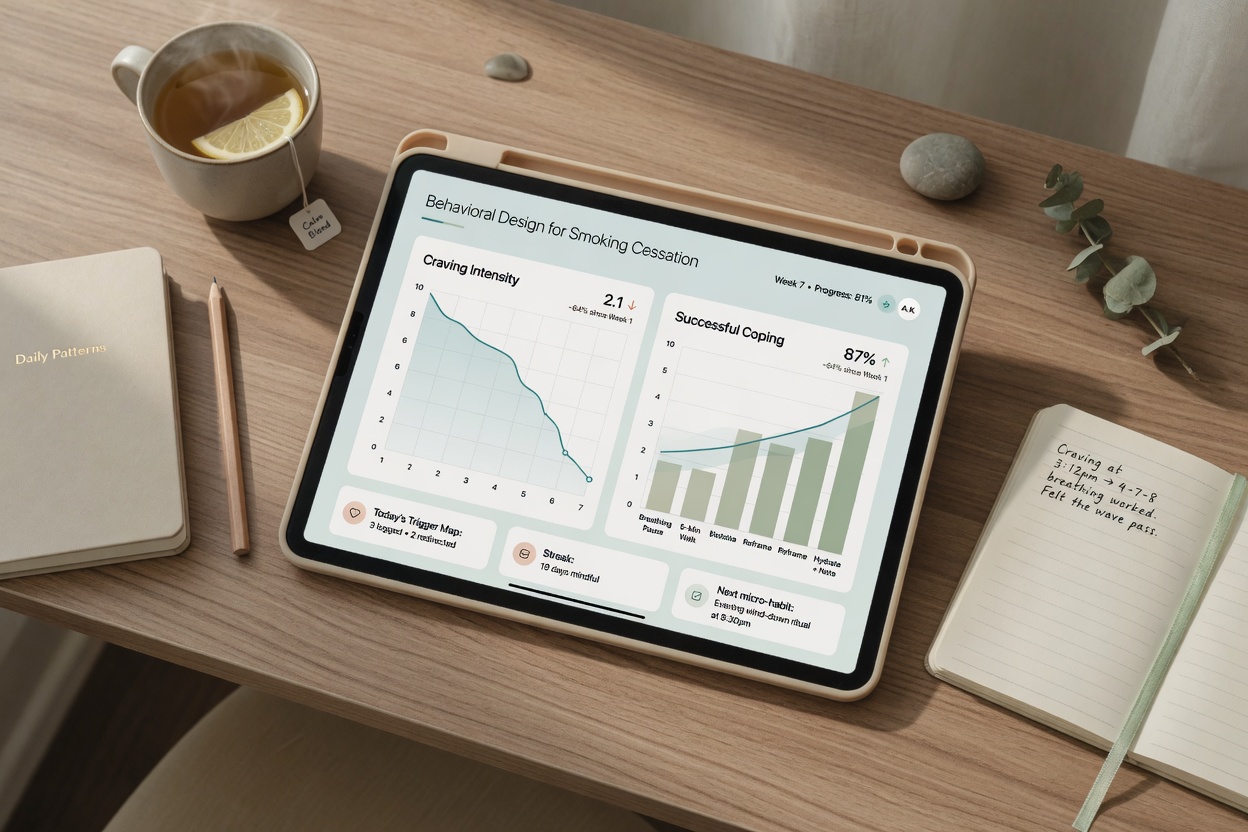
How to Design a Truly Effective Smoking Cessation Check-in and Review Recording System
On a Friday night in November 2023 at 21:40, I stood outside the 24-hour convenience store near my office. I was already holding a lighter, and the cigarette was handed to me by a colleague. Before that day, I had checked in for 19 consecutive days on a smoking cessation app, had a "No Smoking Today" checklist in my notes, and had posted two screenshots in a group chat. About 4 minutes after putting out the cigarette, I opened my phone — the consecutive days count reset to zero, the checklist for that day was unchecked, and the group chat was muted.
What was worse was not that single cigarette, but the script that played out over the next 48 hours: self-shaming → deleting the app → "next time I will rely on willpower" → buying a whole new pack on Monday. The recording system did not help me prevent the slip; instead, it dealt me another blow after the slip: It only declared your failure, it did not tell you what to change next time.
I have since quit several more times and have helped a few friends improve their check-in sheets. After enough trial and error, the conclusion became solid:
**A truly effective smoking cessation record is not about "proving I am a person with willpower," but about "collecting behavioral data detailed enough that next weeks strategy is slightly smarter than this weeks."**
Check-in is data collection; review is decision-making. A check-in without review is just performance.
This article is structured as "Principles → Four-Layer Architecture → Field Templates → How to Use for a Week → Anti-Formalism Mechanisms → Common Pitfalls." You can copy the whole system or just take the minimum viable part.
**Disclaimer:** This article is a health education and behavioral method explanation and does not constitute individual diagnosis, prescription, or psychological treatment recommendations. For severe depression, suicidal thoughts, chest pain, major chronic diseases, or pregnancy/pre-pregnancy related issues, please consult a licensed physician or a proper smoking cessation clinic. The types of apps mentioned are for informational reference only.
I. Why Your Previous Check-ins Were Almost Certainly Doomed to Fail
The ineffective systems I have seen and used myself all look almost identical:
| Common Design | What It Appears To Do | Actual Harm It Causes |
|---|---|---|
| Just check "No Smoking Today" | Complete a ritual | Zero process data, no solution after a slip |
| Consecutive days as the only KPI | Motivate persistence | One cigarette = personality reset to zero |
| Sharing D1/D7/D30 in the group | Social supervision | Comparison, pretense, shame of breaking the streak |
| 20 fields to fill | Looks professional | Abandoned by day 3 |
| Never do a weekly review | "Just recording is enough" | Same mistake repeated 10 times |
In public health and behavioral intervention, self-monitoring is repeatedly used in smoking cessation preparation and maintenance stages: recording smoking quantity, triggers, cravings, and coping strategies — not to submit a report, but to let people see patterns. Domestic and international smoking cessation support materials often recommend keeping a diary: recording what day of quitting you are on, what situations make you most want to smoke, physical and emotional changes, and how much less you smoked.
Meanwhile, clinical and public health consensus reminds us: most relapses occur in the early stage of a quit attempt; withdrawal discomfort is often more pronounced in the first few days, significantly easing within about a week, but cravings and situational triggers persist long-term.
Therefore, the first 72 hours and weeks 1-2 require denser recording and more frequent reviews — not because you have "weak willpower," but because the risk window is objectively steeper.
My personal judgment is more direct:
If daily check-in does not feed weekly decision-making, half the fields should be cut.
Consecutive days can be kept as a "decorative progress bar," but the system main KPI should be:
II. Four Design Principles (Set the Rules First, Then Draw the Table)
Principle A: Records Serve Decisions, Not Moral Scores
Before every entry, ask yourself:
"Can this piece of information help me avoid one pitfall next Tuesday?"
If you cannot answer, do not record it.
Sentences like "I am such a failure" or "I failed again" take up space, add shame, and have zero decision value — they are banned from the main table. Emotions can be recorded on a separate "emotional scratch paper" to avoid polluting the behavioral database.
Principle B: Fewer Fields Is Better Until You Need More
My first version of the table had 14 fields; I stuck with it for 4 days. The second version was cut to 5 fields, and I used it for 6 weeks.
Completion rate > perfection. Survive first, get smarter later.
Principle C: The System Must Accommodate "Lapses," Ban "One Cigarette Reset" Shaming
| Concept | Meaning | How the System Should Handle |
|---|---|---|
| **Lapse** | Brief deviation: one or a few cigarettes | Record the event, do a targeted review, **main line continues** |
| **Relapse** | Return to stable old smoking pattern | Stop loss, rebuild environment, restart |
If an app or table, after you smoked one cigarette, directly changes your identity to "failure and clears all meaning," that is bad design, not honesty. Physical recovery and accumulated skills do not physically reset to zero because of one cigarette; what resets is your narrative. Narratives can be changed.
Principle D: Weekly Review > Daily Check-in
A check-in without a weekly review is like only weighing yourself without ever changing your diet — the numbers move, but your behavior does not.
III. Four-Layer System Architecture
Think of the entire system as four layers, not a "super app."
+-------------------------------------+
| Layer 4 Failure Special Review (24-48h after lapse) |  ← Major patch
+-------------------------------------+
| Layer 3 Weekly Review (fixed 15-25 min)                |  ← Strategy change
+-------------------------------------+
| Layer 2 Impulse Quick Note (30-60 sec, optional)       |  ← Capture peak data
+-------------------------------------+
| Layer 1 Daily Collection (2-5 min every night)          |  ← Baseline data
+-------------------------------------+
Layer 1: Daily Collection (Mandatory, Minimalist)
Suggested time: Fixed 3 minutes at night, or make-up the next morning (allowing make-up is an anti-shame design).
Minimum fields (strongly recommended to start with these 5):
| Field | How to Fill | What It Answers |
|---|---|---|
| Date | 2024-03-12 | Timeline |
| Smoke-free? / Count | Smoke-free or 2 cigarettes | Result layer, brief |
| Peak craving today 0-10 | Highest score, no need to average | Whether intensity is decreasing |
| Main trigger tag (1-2) | e.g., Overtime+Coffee / Dinner+Alcohol | Where patterns come from |
| Coping strategy executed? | Yes/No + which method | Whether strategy was used |
Optional 6th field (still lightweight): Biggest Success Today — "After dinner I wanted to smoke, rinsed my mouth + walked downstairs for 8 minutes and got through it." Specifically trains the brain to see "I can do it" evidence, fighting all-or-nothing thinking.
Layer 2: Impulse Quick Note (For High-Risk Moments)
When craving ≥7, or when your hand is already reaching for your pocket, open a pinned template in your phone notes and fill it in 30 seconds:
Time: __hour__
Location:
What I was doing:
Mood (one word):
Craving 0-10:
I plan to stall for __ minutes
Method used: Deep breathing / Drinking water / Leaving the scene / Messaging__ / Chewing__
Result: Got through / Lapsed (__ cigarettes)
My most useful quick note was:
"23:10 | Home balcony | Stuck on revising a plan | Annoyed | 9 | Planned to stall 10 min | Actually lit a cigarette after 6 minutes."
During the weekly review, this line directly pointed out the problem: overtime night + the balcony as a "reward corner" + not removing cigarettes in advance — not something "I have no willpower" could explain.
Layer 3: Weekly Review (The Real Engine of the System)
Suggested fixed time: Sunday 21:00-21:20, or 20 minutes before Monday commute.
Location can be anywhere, but try to keep it consistent; I used "the window seat at the coffee shop downstairs" as my review spot, because at home it is easy to get distracted by my phone.
The weekly review answers only 6 questions (copy these into your table exactly):
Bad review example:
"I did not perform well this week, I am still too weak, I will definitely persist next week."
Good review example:
"Top triggers: 1. Friday dinner+alcohol 2. Overtime past 22:00 3. Workstation after lunch.
Patches: 1. Drive on Friday (excuse to avoid drinking) and sit at a non-smoking table; 2. Only keep sugar-free gum + headphones in overtime bag; 3. After lunch, take 2 flights of stairs before returning to workstation.
This week KPI: Successfully execute coping strategies in high-risk scenarios ≥5 times."
Layer 4: Failure Special Review (After a Slip)
Within 1 hour after a slip, people are often not suitable for deep review (shame, nicotine just returned, narrative collapse).
A safer approach: Stop the loss first (no more chain-smoking) → Only record 3 lines of facts that day → Do a 15-30 minute five-dimension review when clear-headed the next day.
The five dimensions can be simplified into a table:
| Dimension | Filling Guide |
|---|---|
| Scene | Time, place, people, activity, whether alcohol/cigarettes were available |
| State | Stress, fatigue, hunger, anger, boredom... intensity |
| Thought script | Exact original thought: "Just one" "Since I already broke it"... |
| Preparation gap | Cigarettes not cleared? Plan not carried? No one to contact? |
| Strategy mismatch | Used an ineffective method, or did not activate an effective one |
The output of a special review is not a self-criticism letter, but three patches written back into Layer 3 "Only change 1-3 next week."
IV. Two Templates Ready for Direct Replication
Template A: Minimum Viable System (MVP, recommended for 80% of people to start here)
Medium: One page in your phone notes, or an A4 sheet folded in half and carried with you.
One line per day:
Date | Smoke-free/count | Peak craving | Trigger tags | Coping (yes/no+method) | One sentence
One page per week:
This week data: Smoke-free __ days; Lapses __ times; Total __ cigarettes
Top triggers: 1.__ 2.__ 3.__
Effective methods:
Ineffective methods:
Environmental entry points still exist:
Next week patches (max 3):
1.
2.
3.
3 minutes a day + 20 minutes a week. If you cannot even do this, the problem usually is not "the table is not fancy enough" but rather sleep, depression burden, or cigarettes being still highly available in your environment — those require different levers, not more fields.
Template B: Advanced Version (Add when 2 weeks of MVP still feels insufficient)
Add to the daily collection:
| Additional Field | When Needed |
|---|---|
| Sleep duration | Multiple reviews point to "lapse after staying up late" |
| Alcohol (yes/no) | Dinner-party type lapses recurring |
| Medication/NRT taken as planned | When using nicotine replacement or prescription drugs |
| Emotional main color (1 word) | Emotion-driven smoking is dominant |
| Cumulative money saved | Need positive feedback, averse to preaching |
Still do not exceed 8 daily fields. Beyond 8, I will default that you will abandon it by next week.
If-Then Plan Page (Recommend a separate pinned page)
In behavior change research and clinical smoking cessation counseling, pre-writing "If...then..." reduces decision-making costs during impulsive moments. Write in your own words:
| If (Trigger) | Then (Specific action, startable within 60 seconds) |
|---|---|
| Want to smoke after lunch | Immediately stand up and get water + chew gum + take stairs before returning to workstation |
| Colleague offers a cigarette | "Thanks, I quit" + accept tea with both hands or touch phone (occupy hands) |
| Overtime past 22:00 | Switch workstation away from balcony view + set 10-minute countdown |
| Drinking with a smoking friend | Switch to non-alcoholic drink or leave for air in the first hour |
| Craving ≥8 | Leave the scene for 10 minutes; send "back me up" to designated contact |
During the weekly review, check each plan: Effective / Not used / Used but ineffective. If ineffective, change the action, not your determination.
V. From Day 0 to Week 4: Real Operating Rhythm
Day 0: Build the System (30-40 minutes, done once)
Days 1-3 (Steep Risk Period)
End of Week 1: First Formal Weekly Review
Many people first review turns into a self-criticism. Force yourself to only produce "data + Top 3 triggers + three patches."
The conclusion of my first effective review was very down-to-earth:
"It is not a willpower issue; it is the 12:40 workstation after lunch + coffee iron triangle. Patches: eat lunch in the meeting room, switch coffee to tea for a 5-day trial."
The next week, lapses in the same time period dropped from 4 to 1. The numbers were not big, but the system had understood human language for the first time.
Weeks 2-4
When You "Do not Want to Record After Three Days"
Downgrade, do not blame yourself:
The recording system is a scaffold. A too-heavy scaffold will crush the project.
VI. How to Choose a Medium: Paper, Spreadsheet, App
| Medium | Suitable For | Risk |
|---|---|---|
| Paper notebook | Hate phones, need "ritual of leaving the screen" | Hard to count Top triggers, easy to lose |
| Phone notes | Optimal solution for most people | Gets buried in chat, needs pinning |
| Spreadsheet (Excel/online) | Want automatic counting, weekly stats | Too many fields will discourage |
| Dedicated cessation app | Want timer, money saved, light gamification | Consecutive day shaming, notification overload, feature bloat |
| Habit tracking app | Only manage replacement behaviors like "rinse after meals/walk" | Reduces quitting to one checkmark, loses process |
| Community check-in | Light accountability | Comparison, performance, rumors, trading cigarettes |
My position on choices:
Internationally and domestically, common app capabilities include: smoke-free timer, money saved, health milestone education, craving diary, community. Cognitive-behavioral products encourage recording cravings and triggers, not just showing consecutive days — consistent with this article position. When choosing, check whether it supports "continue after lapse" and "custom tags," not how exciting the marketing copy is.
VII. Special Expose: Seven Ways Formalized Check-ins Die
A month later you only know "I failed 6 times," not that 5 of those 6 times were at drinking parties.
Deleting the app after one cigarette is like destroying evidence at a crime scene, also destroying the opportunity to improve.
The epitaph of perfectionists: "I designed the most scientific table in the world, used it for two days."
Shame drives short-term vows but rarely drives environmental change.
You start lying for screenshots; the record is completely dead.
If the goal is to quit dependence on cigarettes/nicotine, but you do not record real exposure and triggers, the system rewards self-deception. Reduction can be a strategy, but the fields must be honest.
Notifications go from assistant to debt collector. Only keep the high-risk window and daily collection reminders.
Hard anti-formalism rules (recommended to write at the top of the table):
VIII. A Sample Week That "Looks Ugly but Works"
Below is a condensed representation of the real structure (numbers are for illustration):
| Date | Result | Peak | Trigger | Coping |
|---|---|---|---|---|
| Mon | 0 cigs | 6 | After lunch | Yes-Stairs |
| Tue | 0 cigs | 5 | Nervous before meeting | Yes-Water+gum |
| Wed | 0 cigs | 8 | Overtime 22:30 | Yes-Left balcony 10 min |
| Thu | 0 cigs | 4 | Boring commute | Yes-Podcast |
| Fri | 2 cigs | 9 | Dinner+alcohol | No-Accepted cigarette directly |
| Sat | 0 cigs | 7 | Hangover irritability | Yes-Special stop loss+walk |
| Sun | 0 cigs | 3 | — | — |
Weekly review conclusion:
Note: The consecutive day streak broke on Friday, but the system did not collapse — recording continued on Saturday, patches point to alcohol, not to "I am worthless." That is the dividing line between effective recording and useless check-ins.
IX. How to Connect with Other Support
The recording system is a base, not a full suite.
| If your situation | What to add beyond recording |
|---|---|
| Daily >1 pack, multiple failed hard quitting attempts | Consider formal cessation clinic/medication or NRT (follow medical advice) |
| Drinking party always leads to lapse | Social strategies + temporary refusal, not just write one more line |
| Depression, panic, severe insomnia | Mental health and medical evaluation before table beautification |
| Family still smokes indoors | Household rules and third-hand smoke environment, otherwise personal records swim against the current |
| Need companionship | One decent quality companion/group, not five noisy groups |
Use the same "trigger-coping-weekly patch" language for clinic follow-ups, medication adherence, and counseling notes — information will not become fragmented.
X. A Few Personal Judgments I Am Willing to Bet On
Writing to this point, I can be more blunt:
The ultimate test of a recording system is only one:
**The next time the same high-risk scenario appears as last time, is your action already different?**
If the answer is "no" for three consecutive weeks, stop beautifying the table — go change the environment, change medication, change routes, change people.
If the answer starts to become "yes," congratulations — your check-in has finally gone from performance to engineering.
Appendix: A One-Page Printable Checklist
Daily Collection (2-5 min)
Impulse Quick Note (when ≥7)
Weekly Review (15-25 min)
After a Lapse
Reference Directions (For Further Verification)
Tools will become outdated, and fields will be revised.
"Daily data collection, weekly strategy revision, lapses repairable, no shame-based reset" — if these four principles still stand, your system is still alive.
Effective System
Uses behavioral data to drive weekly decisions, lapses repairable
Useless Check-in
Only records consecutive days, shame-based reset after lapse
💡 Card values sourced from original parameters
💡 Comparison shows core system design differences
💡 Patch limit prevents over-optimization